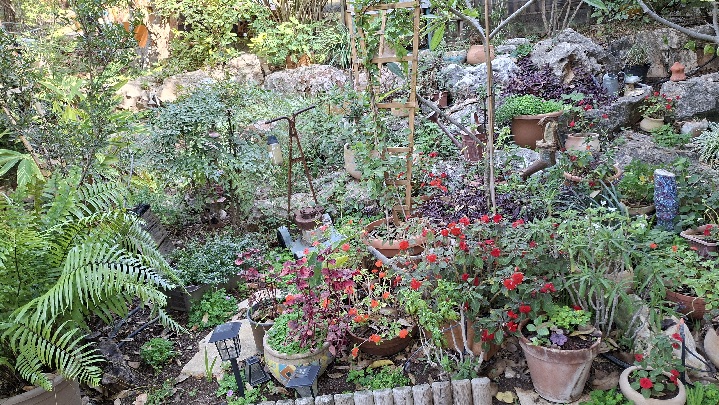
Sufi Festival, 2019, Ashram Bamidbar, Israel. A wonderful celebration of love, spirituatliy, openess. Great music and dance performances with full audience participation. A variety of enlightening workshops in music, dance, writing, spirit and understanding. Inspirational setup in the deep desert of the Arava.
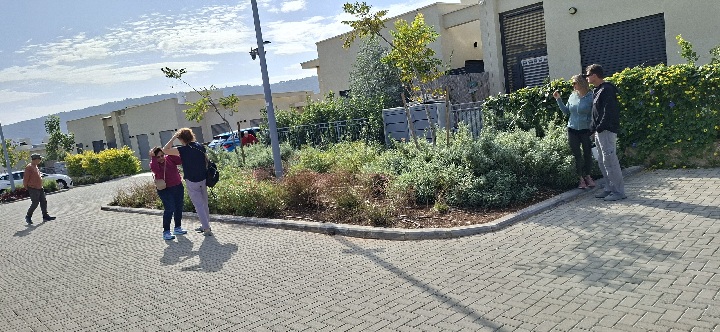
Atzmon, Misgav – First Community Settlement in The Galilee
The move -Settle for your kind of settlement
I moved up to the north of Israel two and a half years ago, curious to learn about everything this interesting region has to offer, from history, archeology and natural marvels to people, religions and lifestyles. Specifically, the Galilee and northern Israel feature an extraordinarily rich mosaic anthropologically (Check, for example my post on Upper Galilee winter traditions).
Within the Jewish community it means, among other things, a wide range of innovative living arrangements. The Kibbutz and the Moshav had historically started here, but the quest for new and different ways still goes on! Personally, I moved into a transformed Kibbutz that had already shed some iconic institutions like the dining room. The communal spirit is still there, though, to my joy.
Always experimenting
Kibbutzim, at the time the most revolutionary form of living ever, are by now mainstream, as well as Moshavim and Moshavot. With time, though, many Kibbutzim, like the one I reside in now, underwent major changes and adaptations, economically and socially. Few kept the old, rigid structures. Nonetheless, with the changing economics, sociology and politics of the country and the villages, a need arose for new forms of settlement altogether.
The spiritual trek
On the one hand, spiritual and ideological groups created so-called “alternative” villages focused on new lifestyles, like organic agriculture, anthroposophical education, vegetarianism and ecology. Some were inspired by Indian and Western philosophies and teachers. Yahad, Hararit, Ma’ale Tzvia, Yodfat and Amirim are good examples. You can google these fascinating communities to learn more.
The “Capitalistic” trek
On the other end of the spectrum, young urban professional couples were interested in community life, space, fresh air and country living, but not in shared economics, agriculture or ideology. They sought a rich social life, safety, good education for their children and shared communal activities, like celebrating the holidays. Atzmon, to be described below, is a good example of that new trend.
The new state of mind also meant that changes and adaptations were more easily made within the new communities overtime. The new villagers were less dogmatic and ideologically-oriented than the early Kibbutzniks, and therefore more easily inclined to ameliorate form and substance as needs changed.
Left: Refreshments at the library.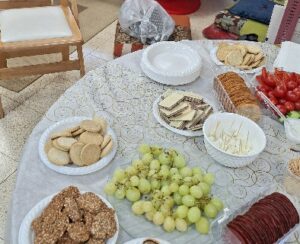
Get to know your neighbors
The Misgav Regional Council comprises of 35 various villages, 29 of which Jewish, and 6 Bedouin. Nowadays, of the Jewish villages 6 define themselves as new Kibbutzim, 2 as Moshavim and 21 as community settlements or villages.
In combination with other bodies, like the senior citizens initiative, and with financial support from the National Lottery, the council took on to organize tours of the various villages. The tours are intended for Misgav residents, interested to learn more about their neighbors as well as for outsiders, who might be interested in moving in. Each settlement would organize its own tour. People would talk about their history, occupations, challenges and success stories. We all would walk or drive around and see recommended points of interest and meet inspiring individuals.
I was enthused, of course, and the first such destination was the veteran community settlement of Atzmon-Segev, one of the first in Misgav.
Typically, in each village there was a woman, who took care of organizing the visit. In Atzmon it was Marga Maor, a wonderful lady, psychologist by profession.
We gathered in the cozy library around tables loaded with excellent refreshments of fruit, vegetables and baking goods for the initial mingling, and then sat around to hear resident Yael Gasko telling us about the establishment of Atzmon, its early tribulations and eventual success.
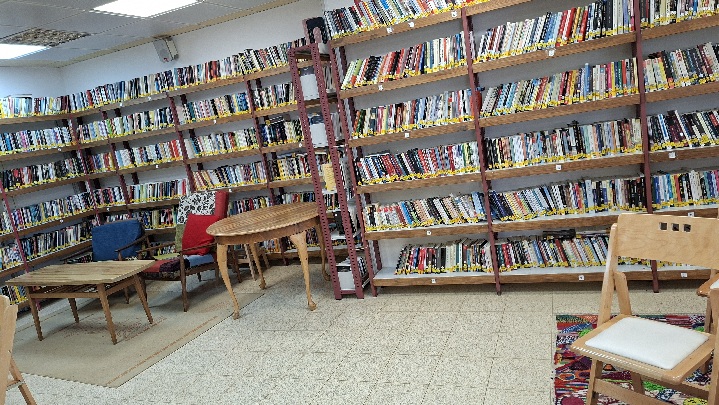 The library at Atzmon community settlement
Labor pains
In 1975, a group of Rafael workers, (Israel’s Advanced Defense Systems), from Haifa and the adjacent Krayot region, was moved to establish a new Jewish settlement in the Galilee. A torch lighting ceremony on nearby Mount Ahim marked the moment and set up the intention in the presence of journalists. The would-be settlers had a calling on a specific spot, where a struggling Yishuv called Segev was already located. Due to lack of water and land for agriculture (the area is very mountainous), Segev established itself as a colony of miners and foresters. They planted the large Segev forest still existing. Eventually some farming was introduced as well, but most settlers had already left the place.
Brave new world
The Rafael gari’n (settlement formative nucleus) was a daring novelty in the Israeli landscape of the time as the participants refused to work on the site or create a local economy. They wanted to keep their existing employments and commute. However, they were willing to invest time, money and energy into building their new communities, so their villages were not modeled after American suburbs.
Yael told us that at the time every new Yishuv had to belong to a settlement movement that controlled the ground allotments from the government. They decided to join the Moshavim Movement. In 1978, 28 families settled temporarily in the Yavor Camp before moving to the final site.
Going capitalistic
The 1977 political change, which favored capitalism over socialism, actually worked in their favor. Yuvalim, which joined the Farmers Association preceded them one year in the Aliya Lakarka (“rising to the land”, literally, meaning getting onto the permanent, final site). For Atzmonites this happened in 1983. The original Gari’n split into Yuvalim and Atzmon, of which 36 families settled in Atzmon. By then Koranit and Shchania, two other similar community settlements, were already established in the Misgav region.
Early life – hybridizing Kibbutz and urbanity
Yael told us several anecdotes from the early days, like how when a small store was improvised, people just came in with given keys, wrote down what they had taken on a ledger, and that sum was deducted from their final salary that month. Everything was handled in good faith and trust..
As a hybrid of Kibbutz and urbanism, the salaries entered the Atzmon common bank account, and after deductions for communal expenses, groceries, etc., were transferred to their individual accounts.
Yael emphasized that there was an ideal of “do it ourselves”, rather than outsourcing tasks and jobs to outsiders.
Eligibility
In similarity to Kibbutzim, Atzmon had an admission committee. Candidates were asked whether they could live there and make a living, and what they intended to contribute to the community. A year of candidacy was required, and later cancelled.
Thriving
Today the Yishuv boasts 380 families plus renters. and more than 600 children.
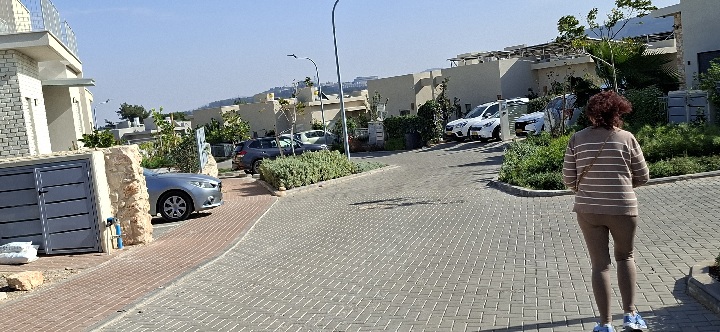 “Stage 11” at Atzmon-Segev. A spacious, accessible new neighborhood.
More information about the settlement of Atzmon and its history could be found here.
Next we drove to the house of Orly Schwartz. Personally I haven’t seen a small community in Israel which did not have its artist, writer, sculptor, ceramicist, etc., but Orly is indeed extraordinary in every way. Originally a teacher, she retired early and turned on to art, starting with transforming her own home into a decorative project….
Her husband, who works in the defense industry, took on to her eccentric household design only gradually, but eventually learned to like it.
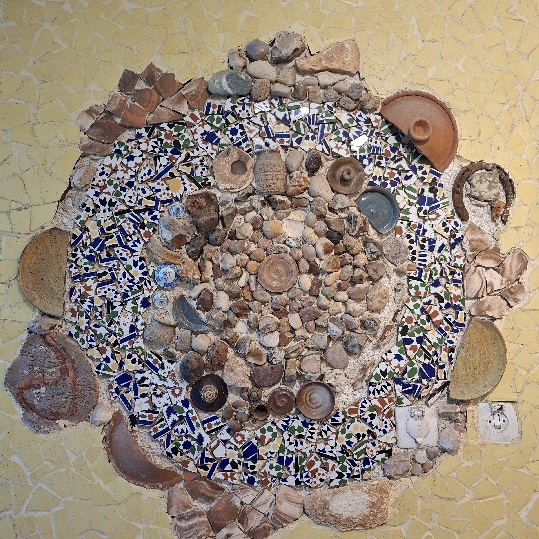 Orly Schwartz, wall decoration from natural materials. Atzmon Segev
Even the garden in front of the house is artistically fashioned, and en route to the actual entrance you could already see Orly’s typical mosaic mélanges and collages installed on the ground and the external walls. In the house itself, parts of the simple typical Israeli sixties floor were replaced with mosaics. Where a wall was removed, a mosaic was placed in the gap. Doors, cabinets, windows, wood stove – all these were transformed into decorative creations. Kitchenware was all ceramics and externally exhibited on open shelves.
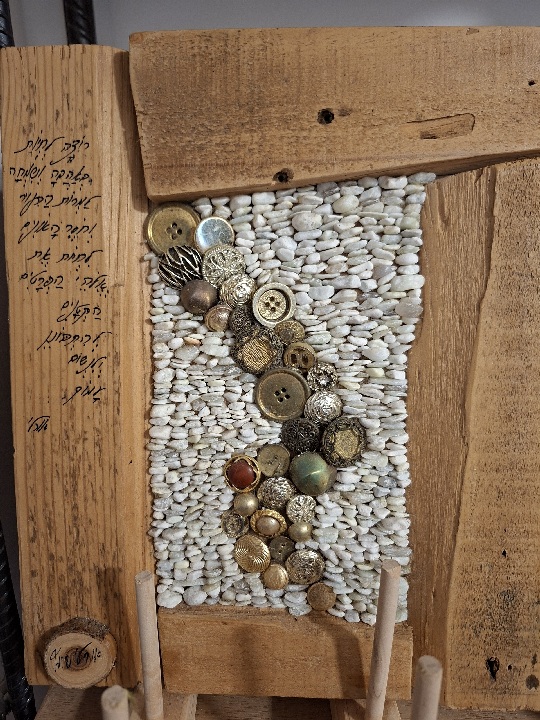 A cabinet door. Artist Orly Schwartz in celebration of the small details of life
Orly uses all sorts of natural material – wood, shells, rocks, acorns, as well as beads, broken glass, buttons, etc. She also gives workshops on the artistic use of recycled and natural materials.
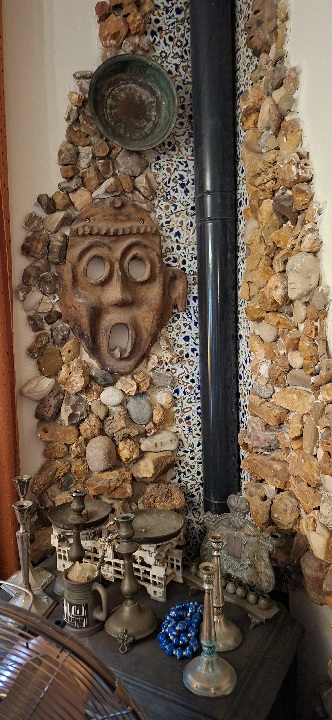
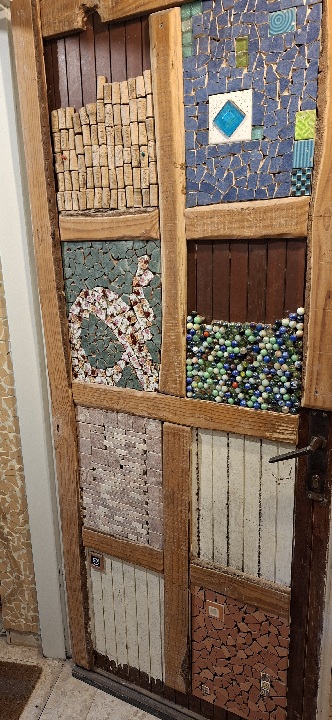
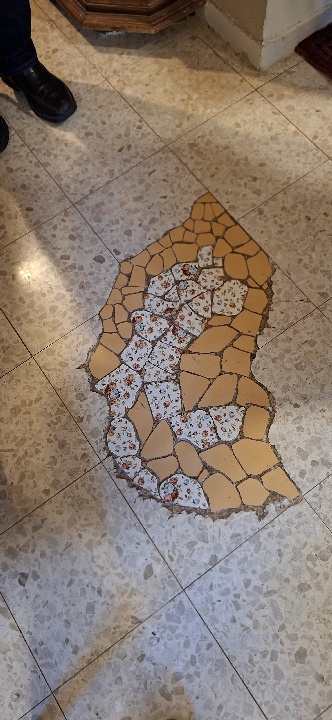
Decorated wood stove, cabinet and floor mosaic, all at the artist’s home in Atzmon Segev.
When we left she gave us each a coaster as a present.
You can find her on Facebook: https://www.facebook.com/psefas.mimaamakim
Next we took a short walk to visit the new Atzmon development – Stage 11 as it is called. Villages and new neighborhoods in Israel are often developed in “stages”, and advertised to buyers as such. Stage 11 is a very spacious, airy, comfortable neighborhood, with gardens, garages and all the facilities. The main innovation here is that the houses are pretty much flash with the street, avoiding steps and stairs, which can be a hindrance to elderly or handicapped individuals. But the neighborhood is primarily designed to answer the needs of two-car middle class families with children and even for singles. Rental units are available. The settlement treasury contributes some interim financing until the houses are inhabited. Once a year they conduct a “street meal”. Eleventh stage subdivision at Atzmon-Segev. Spacious, accessible.
Considering all, this is heaven in comparison with what people get in cities for much much more money, but people either don’t know, or don’t realize that the so-called “periphery” can offer such rewards for their shekels.
Last but not least, we visited a bomb shelter artfully rendered into a memorial for the October 7th Holocaust. The unique installation is dedicated to two Atzmonite youth murdered in the so-called Death Shelter (Migunit Hamavet) – Segev Kijner and Ayelet Arnin, and to the Kutz family from Kfar Aza, slaughtered in its entirety by Hamas – Mother, father and three children, whose bodies were found hugging each other in their home.
Wings of Hope
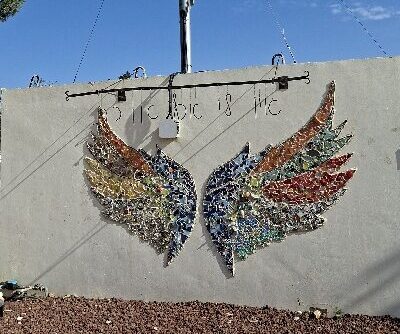
This project was carried as part of a country-and global-wide effort to memorialize the victims of the October 7th Holocaust. The idea sprang from the creative project launched by Livnat Kutz herself, just three months before her brutal murder and that of her family. Her idea was to use old and broken toys to create a beautiful exhibit, Wings of Hope, on a bomb shelter wall in Kfar Aza. The wings symbolize the values of “sustainability, creativity, and a sense of optimistic community belonging—values that Livnat and her special family embodied“.
A side and sad comment on the futility of fighting extremism with love
In this context I feel moved to comment that the border communities burned, raped and brutally massacred by Hamas and “non-involved Gazan citizens” were some of the more peace-seeking, Gaza-helpful and Palestinisn-positive in the land of Israel. People got out of their way to help Gazans into Israeli hospitals and to give them jobs, only to be spied upon in their own homes prior to the attack. None of their good deeds helped them when drugged and brain-washed mobs crossed the border on October 7th, as the case of Vivian Silver so sadly demonstrates. That kind of hatred is incurable by facts or kindness.
The global Wings of Hope vision is to replicate Livnat’s effort by commemorating her “deep dedication to community and resilience, ensuring her memory lives on.” The Atzmon community in their own way did just that:
Splinters turned Wings
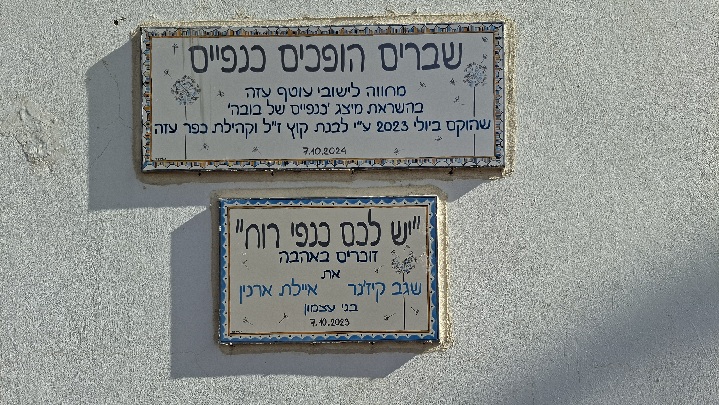 In memoriam of two youth from Atzmon-Segev murdered on October 7th.
To actualize the dream, a call was made for residents to bring colorful ceramics, plastics and other materials. For three weeks those were collected, to then be broken ceremoniously by a “shattering team”. The pieces were glued in a complex process explained to us (lost on me…) by Nili Foyerstein, who showcased the installation. With delicate touch she caressed the beautiful ceramic plaques in memoriam of the two youth and the Kutz family over and over again, obviously being deeply moved and connected to all they express and mean to her..
Appendix
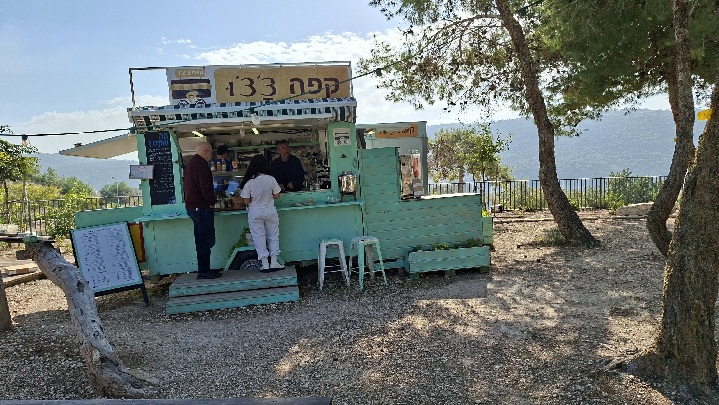
The installation is located near a container turned coffee cart. I closed the visit with tea and sandwich in the company of an elderly guy I met there. He told me his life story being hidden away from the Nazis, and his travails around this country as well.
Our next visit is to Gilon, a large and successful community settlement. Looking forward.

Related Posts


[…] Communities are mostly small and spread apart. Tzfat, with 39,000 inhabitants is the only “city” and is considered the “capital” of the Upper Galilee. Kiryat Shmona, Rosh Pina and the Galilean Hazor are basically towns. The rest of the population lives in an assortment of villages of many styles (e.g., look for my upcoming post: Atzmon-Segev, first Community Settlement in the Galilee). […]