


Tel Dan Nature reserve hosts the largest, most vigorous tributary of the Jordan River. Lush vegetation year-round, ancient grand trees, historical sites go back to Canaanite period. AND: fantastic fish restaurant/farm nearby.
Winter Holidays in Israel’s Upper Galilee
Within ten days of December this year (2025), I participated in two winter lights tours in the Upper Galilee – a Hanukkiah trip to the town of Tzfat (Safed) and a Christmas trip to three Christian villages.


Left: Illuminated reindeer in Fasuta. Right: Outdoor Hanukkiah in Tzfat
The tours were conducted by the senior communities of Kibbutz Moran, Kibbutz Farod and the Misgav Regional Council.
The Upper Galilee (see below) is rich in ethnic and religious traditions. On these two tours we became acquainted with two winter traditions – the Jewish Kabbalistic traditions of Tzfat, and the Greek Catholic Christmas spectacle in the Christian villages.
A haven for minorities
The Upper Galilee is a mosaic of religious and ethnic communities. Some, like the Bedouins, have reached the area voluntarily, seeking good pastures; others looked for land suitable for planting orchards and vineyards; but many others came here due to persecutions. Accordingly, the villages are either hidden within the hills, or placed in inaccessible locations higher up, and the dwellings are often well fortified around central courtyards.
The Ottoman period was characterized by rulers’ tolerance towards diversity, and Christians were encouraged to live there, as well as Jews and Druze. Giving refuge to Christians was also done due to political considerations in efforts to improve relations with the great Western empires of the time.


Painted glass windows in Tzfat
A rough terrain
 The climate and terrain are not favorable for field crops like wheat, barley, garbanzo beans or cotton, and agriculture is focused mostly on fruit requiring a cold season, like apples,cherries, and vineyards.
Communities are mostly small and spread apart. Tzfat, with 39,000 inhabitants is the only “city” and is considered the “capital” of the Upper Galilee. Kiryat Shmona, Rosh Pina and the Galilean Hazor are basically towns. The rest of the population lives in an assortment of villages of many styles (e.g., look for my upcoming post: Atzmon-Segev, first Community Settlement in the Galilee).
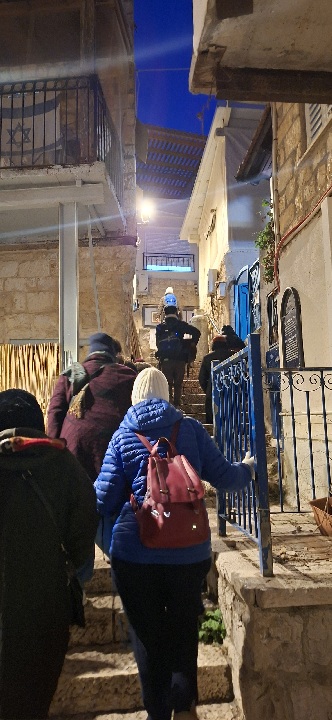
Left: Our group toiling up Tzfat’s many stair alleys and streets.
Exchanging populations
Our Christmas tour guide told us about an 18th century independent and powerful Ottoman administrator, Daher al Umar, who decided to exchange populations between mixed villages believing it will diminish conflicts (Try this today, folks. Good luck!!). Muslims were moved to Tarshiha, while Christians were concentrated in Fasuta and Mi’iliya villages. Later on, specifically for these villages, Muslims moved back in anyway, but during the Independence War most escaped to Lebanon, and these two villages stayed practically Christians-only until today..
The mélange of sects and communities includes alternative Jewish settlements, Druze, Circassians, and a variety of Muslim and Christian groups and sects.
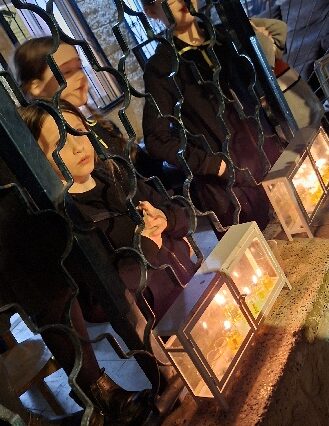
It is a custom many households follow to place the Hanukah menorahs (Hannukiyot) outside their homes on the window sills, in a niche on a fence, or even on the sidewalk. The idea is to spread the light and the miracle of Hanukkah into the world. Candles are usually weather-protected by a glass or plastic aquarium. The effect on a cold winter night is magical.
Sweet girl faces illuminated by the Hanukkah candles, Tzfat
Outside of Israel, Jews usually don’t feel safe enough to place the menorahs outside.
Tzfat is one of the four Jewish holy cities, also including Jerusalem, Tiberias and Hebron. Tzfat hosts multiple synagogues and study houses, and is famed as a center of Kabbalah, the Jewish mystical tradition.


More outdoor Hannukiyot in Tzfat. The one on the right also features a Sevivon (Dreidl)
Already as we disembarked the bus in Tzfat, we felt “the Buzz”- the ancient city was filled with humming and singing.. Groups and troupes of singers and revelers walked along the narrow streets, filling the air with guitar chords, flute and violin sounds. At one corner two guys with beards and kippahs were playing trombone and cello.
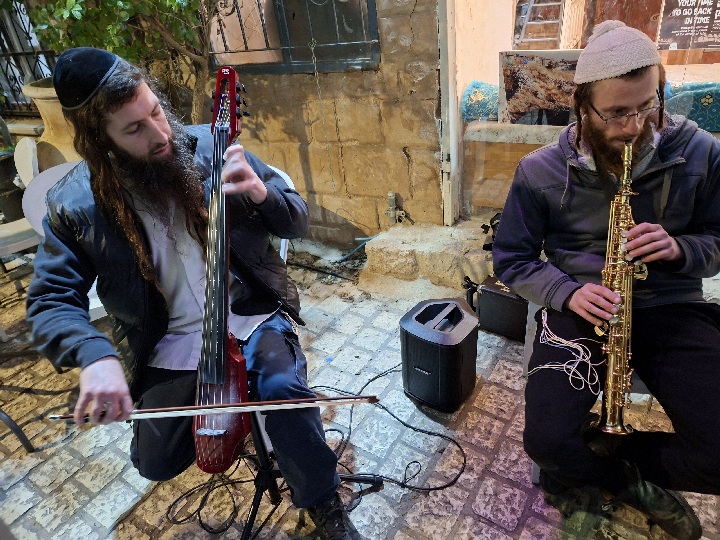 Playing music on Tzfat’s streets on Hanukkah night
Our own tour was also a “singing tour”. The guide, a nice frindly chap, played guitar and sang and we sang along, mostly Hanukka and religious songs, but also songs of the Land of Israel.
As narrow as it gets
According to our guide, Ztfat also boasts the narrowest alley in the land, even registered in the Guinness Book of Records. The step-alley is only 60 cm wide and can allow only one person to go through it at a time. It faces the grave of Rabbi Shimon Bar Yochai in Meron.
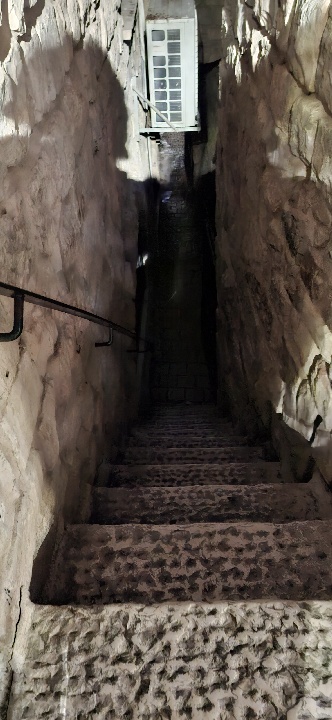
According to Kabbalah traditions, the Messiah will come from Bar Yochai’s grave towards the Galilee Mountains and from there to Jerusalem riding on a white donkey.
Hosting the Messiah
But the alley is famous for another reason he shared with us; a story about an old lady who was sitting daily at the top of the stairs, waiting for the Messiah to pass through.
Tzfat tradition alleges that the prophet Elijah revealed himself to the old lady, Yocheved Rosenthal, in a dream, telling her that the Messiah would pass through her home in the alley. Since then, she had prepared a table in his honor every day to welcome him.
Right: messiah Alley, Tzfat
Yocheved would wait daily with food, as well as a cup of tea and a cup of coffee, worried that she had no idea which beverage the messiah preferred. The neighbors thought she was crazy, but she was unyielding. Eventually, as she grew older and had a hard time climbing up and down the steps, the city installed guard rails in the alley to assist her. She died in 1985 at the age of 100.

And I say, how is she any crazier than all these self-important males who invented the imaginary figure of the Messiah in the first place, and keep calling and praying to him every day instead of going to the army and defending the country?
Left: Nitzan, our tour guide, playing for us at the top of Messiah alley.
Below, Yocheved Rosenthal waiting for the Messiah
At one point we went down stairs and found ourselves in the famed “Tunnels of Tzfat” featuring mi;tople levels. There was water in many places, one of which was clearly a mikveh, indicating Jewish presence. We walked along long spooky corridors, which opened up occasionally into roomier spaces where we gathered, talked and sang, or onto more steps. Our guide tried to speculate how they warmed the water in that Mikveh. When necessary artificial lights were illuminating our way.

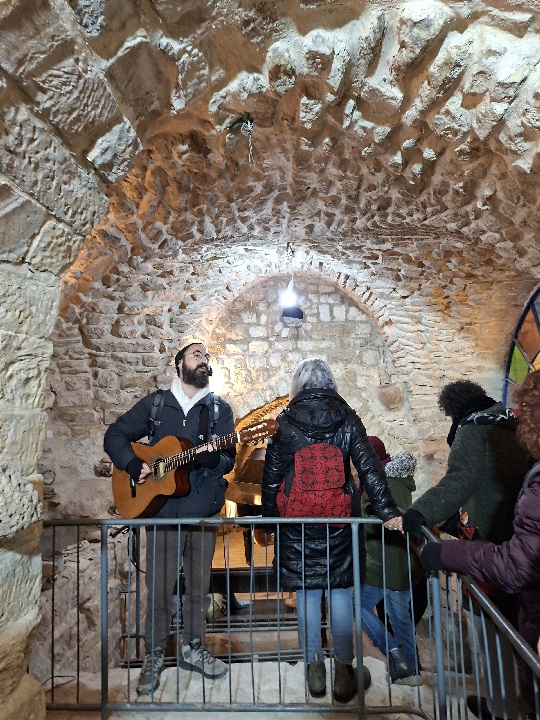
Left; the Mikveh. Right: singing in the tunnels
Even after all the time we spent there, I was not clear what the tunnels were for or about, but this Land had been dug habitually since time immemorial, so it’s in the DNA. According to the Safednofesh site,”Over the centuries, [the tunnels] served as shelters, defensive hideouts, and transportation routes for the city’s residents, especially during times of conflict.” I could not find any further, more precise, information about periods and uses, but that does not mean you cannot find this information somewhere….
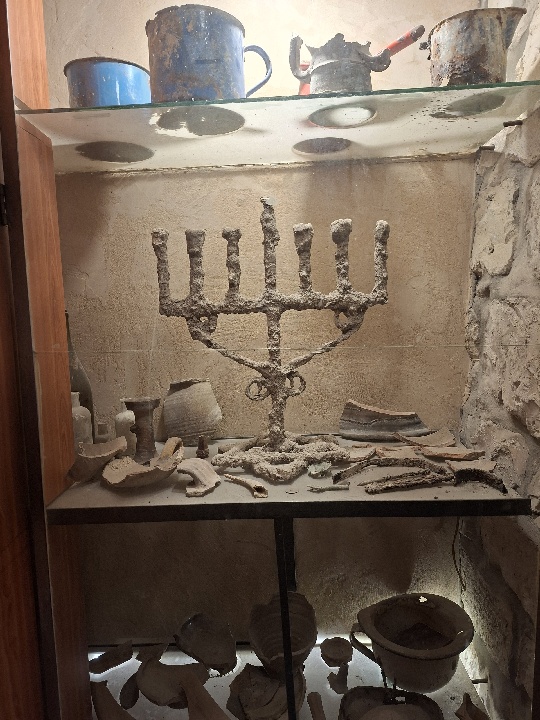
An earthen Hanukkiah installed in a wall niche in one of Tzfat’s tunnels
Eventually we arrived at a large, hospitable space, where chairs and big pots of warm couscous soup were awaiting us, most probably cooked by females. Notably, we haven’t seen or heard a single local woman during our entire Tzfat sojourn, apart for visitors, of course. It’s a male dominant religion and culture, almost like any in the Middle East.
Prior to gulping down the soup, one of us put on a kippa he incidentally found on the street, did the blessings, lit the five candles, and we joined to sing the Amen.

A space attributed to Rabbi Isaac Luria. We had a candle lighting ceremony of our own, and enjoyed a hot soup.
The place was found in an excavation, and was seen firstly as a cave, though later it became clearer that it was used for hosting events and celebrations. It was attributed to Rabbi Isaac Luria or the Holy Ari, as he is better known, but there are no valid proofs of that, other than that the place had been used in the same years he was presumed to have lived in the city. There are two synagogues for him, one Sephardi for his maternal origin, and one Ashkenazi for his father’s.
Unlike the rambunctious Hanukkah atmosphere of Jewish Tzfat, the Christian villages were almost eerily quiet and empty. Barely a man was seen walking. There were few cars on streets that were lit fantastically with Christmas lights and decorations. Recorded Christmas songs were heard in certain sites, but nobody but us was listening to them or adoring the spectacles.
In the past, I was mostly familiar with Christmas in Santa Fe, New Mexico, famous for the Farolitos and luminarias, tof the southwestern Hispanic tradition. Here the decorations were different, but no matter where Christmas is celebrated, it is always a marvel to the eyes..
Note: Crime in the Arab sector has generally risen to such levels that people are afraid to get out. It is surprising to see that also in the Christian villages. Sad.
 A Fasuta house beautifully decorated for Christmas
Our informative tour guide did not miss a minute on the bus to tell us all about Christianity, and also gave us some stats about the Christian population in the Holy Land.:
The total number of Chrsitians in Israel is 180,000 or appr.1.9% of the population, of whom 40% are Greek Catholics, 30% are Greek Orthodox, and 20% are miscellaneous, including Armenians, Copts, Maronite, Protestants and others. Also counting under the “others” are new immigrants from the Former Soviet Union, who did not define or declare themselves to be Jews. Many of them live in Nof Hagalil, formerly Upper Nazareth.
The Greek Catholics call themselves “Malkites” or “Melchites“, from the Semitic root Melech (king). The name refers to their loyalty to the Byzantine emperor, and became a denominational designation.
A minority within a minority
 Left: Palm leaves and Christmas lights on a house in Fasuta, Galilee
The Christian population in Israel is highly educated. Fertility is only 1.6 kids per woman. Both genders hold academic titles and degrees, which by itself usually explains the low fertility rate. On top of that, there is high emigration. Many do not feel comfortable being a minority within a minority, and even more pronouncedly so as the Muslim population expands. They also have more opportunities abroad in Western countries due to their professional status, skills and to a lesser extent, religion. The two villages we visited, for example, brag the highest number of doctors per capita in Israel.
High concentrations of Christian Arabs in Israel can be found in Haifa, Nazareth, Jerusalem and Nof Hagalil. On the use of the term “Arab Christians” see below.
Preceding Islam
Our guide insisted that Israeli Christians are NOT Arabs. According to him, Arabs are those who came from the Saudi peninsula and are Muslim. The Israeli Christians were here previously, or immigrated here later from established communities in Lebanon, most probably due to persecution.
The question of Saudi “blood”
I challenged him that Saudi “blood” within Middle Eastern populations is probably very low, so if Saudi “blood” is the determining factor, most Middle Easterners who call themselves Arabs are not Arabs. The world was not invented in the 7th century when a bunch of Bedouins went on a bloody rampage around Asia and North Africa, forcing their new religion and language on the existing populations.
Identity under constant imperialistic pressures
What happened in the real world was a total, brutal and cruel conquest, where identities across the Middle East were obliterated and replaced with the idea of Ummah, or a pan-Arabic, pan-Islamic “nation” forced upon them by the conquerors. Ask an Iranian or a Turk if they are Arabs, and they will be ready to murder you, but yes, they are Muslim. Imperialistic pressures coerced them all into accepting this religion. I argued that the Egyptians have little Saudi “blood” or DNA, and the same probably for the Syrians, yet they call themselves Arabs. Spaniards, Portuguese and French don’t call themselves Roman because they were conquered by Rome, which also eventually forced a religion upon them, and Latinized their original languages.
For lack of a better term, though, the misnomer “Christian Arabs” for that minority stuck, like many other non-precise and misleading terms influenced by the dynamics of history.
Village demographics
As mentioned above, in the 18th century Dar al -Umar separated Christian and Muslim populations in the Galilee to prevent and abate conflicts. The two villages, Fasuta and Mi’ilya, became de-facto Christian-only settlements. The Muslims were moved to Tarshiha, and Christians were moved out of there. Over time, though, Muslims moved back in, but during the Israeli Independence War the Muslims escaped up north, while the Christians, favored by Ben Gurion, stayed, again making the two villages Chrsitian-only.
Theological adaptations to a dynamic reality
A number of modifications were employed by the churches to ease life for the Christians in The Land. Firstly, they were allowed to pray in the local language, Arabic, rather than Latin or Greek. Secondly, compromises and adaptations in prayer style and church structure were enacted, allowing Orthodox adherents to attend Catholic churches and vice versa. Specifically, Catholics do not have a partition (Iconostasis) between the congregation and the priest, typical of Orthodox houses of worship. The Catholic churches we saw in the villages either had that kind of partition, or a partial one.

The great schism
The schism between Catholic and Orthodox dates back to the 11th century. It was a critical rift. Structurally, the Catholic church was centralized with a single predominant Pope based in the Vatican, while the Orthodox denomination has 5 high patriarchs based respectively in Jerusalem, Damascus, Alexandria, Rome and Constantinople, now Istanbul.
Additionally, Catholics do not allow for priests’ marriages; Orthodox permit married men to become priests. Unlike the Catholics, the Orthodox do not accept three-dimensional images, that is, sculptures. Their churches are loaded with the two-dimensional images, known as Icons. According to the belief, an icon is a window to the sublime.
Even the bread given at Eucharist is different: Catholics use unleavened bread, as expected of the good Jew, Jesus, in his last Seder meal, while the Orthodox do not……
Walking the night streets
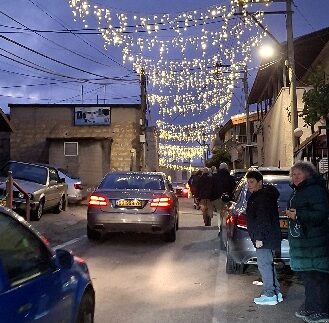
Fasuta village street decorated for Christmas. Galilee
The visuals of Christmas in the villages were STUNNING! As a Jew, I was always jealous of Chrisman, peeping with all the other kids to see the only decorated tree in West Jerusalem at the YNCA. Today there are many more trees, and even Jewish households might display them, especially in houses of immigrants from the former Soviet Union, but not just..
We have seen two marvelous churches, one in Fasuta, one in Ma’ilya. When we reached the top of the hill to the Ma’ilya church, it started raining quite heavily, but an illuminated canopy of little bulbs sheltered us for a while until forced to walk down a few dozen steps back to the bus.

Related Posts


Comments (0)