Sufi Festival, 2019, Ashram Bamidbar, Israel. A wonderful celebration of love, spirituatliy, openess. Great music and dance performances with full audience participation. A variety of enlightening workshops in music, dance, writing, spirit and understanding. Inspirational setup in the deep desert of the Arava.
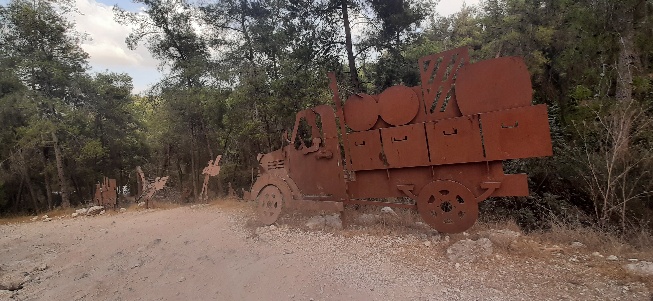
The Burma Road – 1948 Heroism Revisited
Every Israeli who knows anything about our history, has heard of the Burma Road. The road was rush-constructed under peril and hardships in order to bypass the bombarded main road to besieged Jerusalem during the 1948 Independence War. As kids we were told about it over and over by parents and teachers, yet somehow until the trip described below, I have never had the opportunity to actually go there or even know its precise location.
 Israeli Burma Road under construction in 1948
Why Burma?
The name is derived from a similar, though much greater, construction effort used by the Chinese to bypass Japanese Coastal blockades during the Sino-Japanese war in the thirties. Naturally, everything in our tiny country is smaller. The original Burma Road was a 1,150 km stretch, and was built by roughly 200,000 Chinese laborers, using minimal machinery.
The Israeli “Burma Road”, in contrast, spanned only about 10 km. To construct it over the contour of an ancient “gazelle path”, two hundred men from the Home Guard (Mishmar Ha’am) worked diligently to cover the five kilometers which were impassable for vehicles (see below, “The Serpentines” and the Appendix ). Supplies were brought over the backs of mules. The men, mostly conscripts in their fifties, each carried a 20-kilo load and made the trip twice a night. This effort lasted for five nights.
The personal angle
I have a personal angle in this story. My mom and older sister were trapped, like everybody else in the besieged city, with hardly any water or food for months (see Appendix for expanded historical background), living on one bucket of water a week. No protest movements were organized abroad to decry the “humanitarian situation”, no flotillas loaded with “activists” approached Tel Aviv.
My family will never forget the joy when the first convoy came up from the coast to bring them supplies. This was made possible by the newly constructed Burma Road.
Like most men his age, my father, all this while, was mobillized, with the occasional visit to see his wife and daughter.
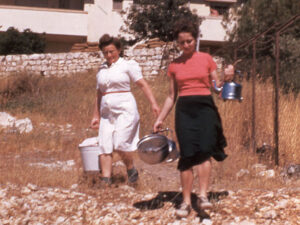 Archived painted picture of women carrying the water quota during the siege of Jerusalem in 1948
The evolution of this post
Life sure has its ways. I embarked on this topic after a tour I took with a friend of the Burma Road during Sukkot vacation, October 2022. He read my posts about Bab El Wad and Khan Sha’ar Hagai, thought I would find interest, and offered to take me on a combined jeep and walking trip to the famed Burma Road.
I wrote the first draft right after the trip, but did not proceed to publishing. There were too many other things happening in the contemporary scene that captivated my attention. Only now in 2026, sitting at home under Iranian missile fire, I somehow found the mental space to complete the post and bring it to publication. I believe this timing is quite auspicious.
Unexpected development – more family connections
Also, pretty prodigiously, at the last minute before publishing, I learned that, as children, my brothter-in-law and his sister actually rode on the very first convoy to break through the historical Burma Road in 1948, with their mother.
Consequently, I posted Yael’s authentic period story she courteously translated for me into English, prior to the description of my own trip over the Burma Road 74 years later in a free and liberated Israel.
The Appendix gives the historical background and meaning of the dramatic events this humble road represents and this humble post is trying to bring to public awareness.
To read about Yael’s story and my trip keep right through or press your selected links at the contents box above. To learn more about the historical background, scroll down to the Appendix, or press on this link.
Keeping the family together
“It so happened that Eli, mother and I were among those who “inaugurated” the Burma Road.” This is how Yael, my brother-in-law’s sister, started her amazing account of this event. At the time of these events she was 7 years old and Eli was 3.5.
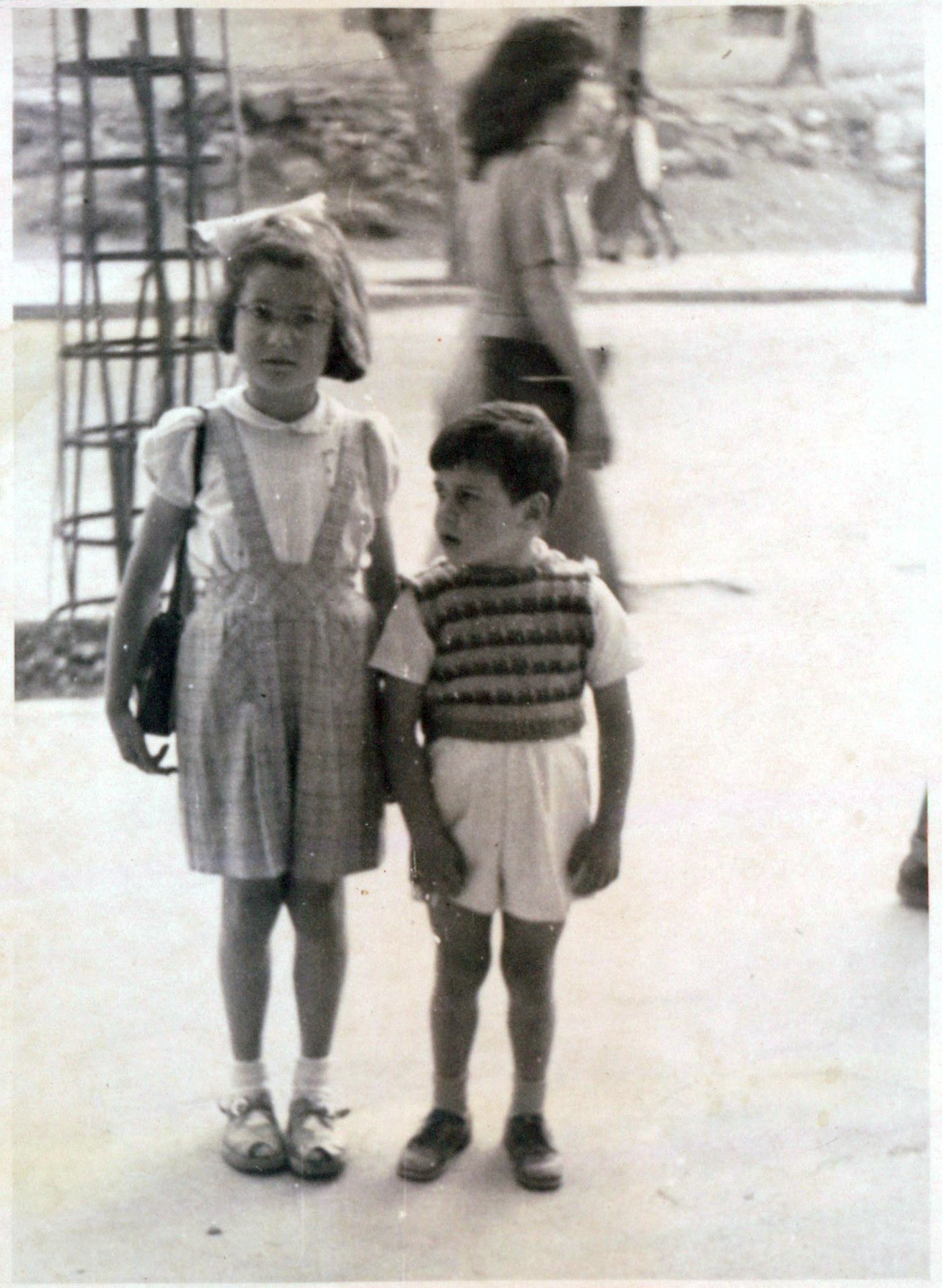 Eli and Yael in Jerusalem childhood
“Before the Hafuga [temporary cessation of hostilities during the 48 Independence War] father, who was serving during the war in the science corps , had to travel to Tel Aviv on a mission . Mother was urging him to let us join him, partially because she insisted that, for good or for bad, the family should stay together, and partially because she felt that her younger sister, who lived in Tel Aviv and was about to give birth, needed her support.
Unlike father, who traveled for his army mission, Mother, Eli and I, as citizens, needed a document giving permission to leave the besieged city.
This fact I learned only years later when reading a newspaper story about civilians who left Jerusalem during the Hafuga. The article, illustrating a certificate of this kind, showed a photo of ours as an example. The certificate included our photos and names. The article was written with a shade of criticism of the “deserters”. It is lamentable that we, who actually returned to the city right after the Hafuga, were referred to in this way.
The trip to Tel Aviv took place in a civilian convoy of fortified buses. We traveled on the regular road to Tel Aviv, via Latrun, escorted by vehicles of UN soldiers. I can’t remember if father was with us or whether he arrived in Tel Aviv separately with the army.
Mattresses in the bathroom
We stayed at my aunt’s, and I remember that Eli and I, along with our cousin, were sleeping on mattresses in the bathroom. This is how we were shielded from the air strikes that the Egyptians continued to conduct, ignoring the Hafuga.
The trip back to Jerusalem we did with the military. Eli and I were the only children in a convoy of armored vehicles full with soldiers. We left Tel Aviv at around 2 pm, reached the Burma Road a bit before 4, and finally arrived in Jerusalem only at midnight!!
It might have been the first time that a whole convoy, and not just few vehicles at a time, traveled the road that was actually nothing but a unpaved wide path along the side of the mountain ridge.
My memory of that trip remains vivid and coincides with the archive photographs of the trip over this treacherous road.
Burma road contruction, 1948 (Source: Wikipedia)
Wheels in the air
We proceeded very slowly and often stopped for long periods of time without being given any explanation. Once in a while we were asked to get off the vehicle as the road became so narrow that only two wheels of the buses touched the ground and the two others were hanging in the air, with a precipice to one side. The soldiers were asked to leave the vehicles, and standing over the cliff they supported the vehicles while the drivers progressed very very slowly, wheels literally in the air.
Till today I feel the horrible fear I sensed then. Eli, in contrast, was in the seventh heaven. When we got off the vehicles he would run around among the soldiers, a favorite of them all! Eli was maybe too young to experience fear, but mother, who understood the seriousness of the situation, was really brave, concealing from us any signs of anxiety. I am not clear how she took care of our needs for food and bathroom on this endless trip.
I cannot remember now at which street we left the convoy when arriving in Yerushalayim. At that time we were staying at my aunt’s father-in-law’s house in Rehavia. We had to temporarily move away from our apartment in Kerem Avraham because that neighborhood was under non-stop cannon fire.
To get there we walked in the eerily empty streets of Jerusalem – mother, father, Eli and me. Father carried a Jerrycan full with kerosene, a very precious commodity at that time, the only thing we brought from Tel Aviv, but as mother wished we were all together.”
Road confusion –
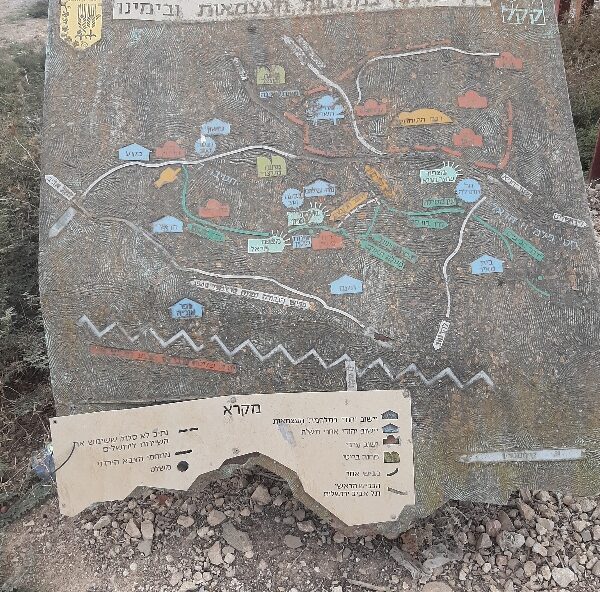 This map was posted on the actual Burma Road. Very hard to read, not in good shape, and confusing by design.
 Map of the Latrun area around 11 June 1948. Main Israeli-controlled area to the west; the West Jerusalem pocket in the east. The Burma Road was established south of the pre-war road between the coastal and Jerusalem areas, thus bypassing the Jordanian-controlled area around Latrun. Source: Wikipedia
 Here the Burma Road shows in red, and the main road in white. (source, https://he.wikipedia,org/ wiki)
From the bottom of my heart I wish you good luck trying to figure out these maps. I, a person lacking any sense of direction, a GPS-dependent entity, am entirely lost. You are on your own here.
The Elusive Burma Road
For years I mixed up in my mind the old road to Jerusalem, the one which circumvented Latrun from 48 to 67, with the Burma Road. But now that I have actually driven over it, I understand why people could make that mistake
After stopping at the Alexandroni Memorial (see below), my friend, looking at one topographic, high resolution map after another, took me on a narrow dirt road around a withering post-season vineyard. I told him this can’t be the famous road; it is just one of a zillion access roads like it around Israel, which typically surround plantations and vineyards. He insisted on being right, and lo and behold, right past the vineyard, we came across a small dirt road junction marked with a Hebrew sign announcing
“The Beginning of the Burma Road“.
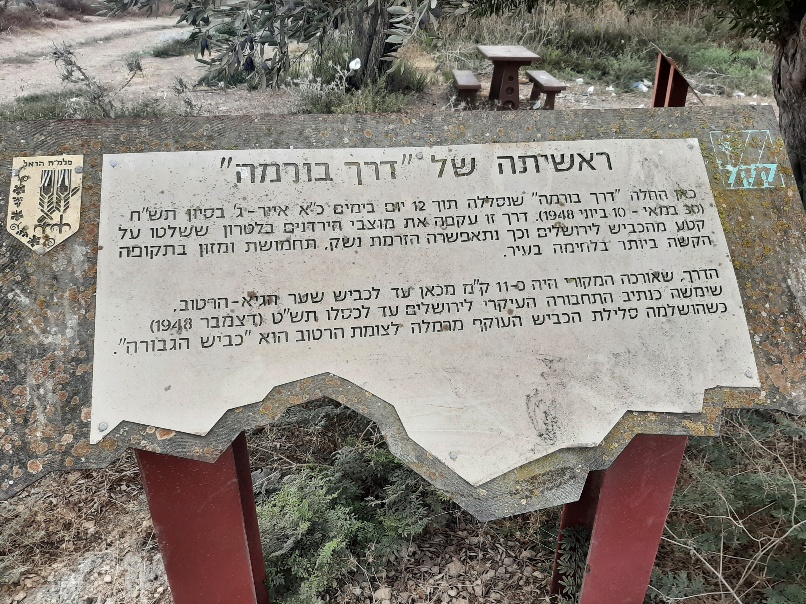 Sign announcing the beginning of the Burma Road
After that I did not argue any further and trusted my friend’s judgement in leading us along the elusive Burma Road, which proved again and again why it cannot be found by normal homo sapiens not equipped with 4x4s, some esoteric knowledge about its whereabouts and a stubborn urge to find it!!!
Even before we have reached the actual Burma Road, there were already plenty of “signs” we were in a history-laden zone. A small dirt road led to an area containing a cluster of elements:
- a monument in memory of the fallen of the Alexandroni Brigade, the unit who fought at Latrun in 1948, consisting of a hollowed stone sculpture and revealing a metal torch to be lit on Memorial Day.
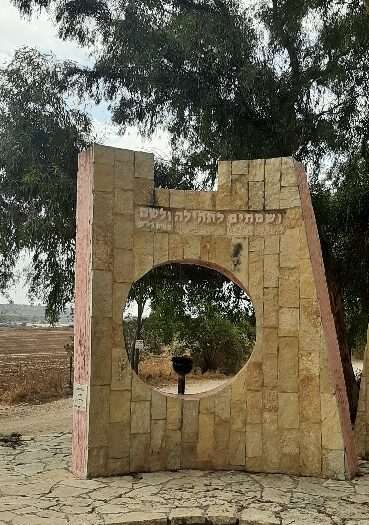 Alexandroni Brigade Monument
- a plaque describing the Latrun battle,
- a name memorial for the fallen of the Alexandroni Brigade
- a monument for Jewish undergrounds members who were held at detention camps in the Latrun area.
This location was chosen for the monuments, being such an excellent viewpoint over the relevant sites. The British Latrun detention centers were initially used to hold Italian and German prisoners of war captured at the North African battlefields, but later adapted to detain Jewish, as well as Arab, “rebels” against the empire, including leaders of the Yishuv.
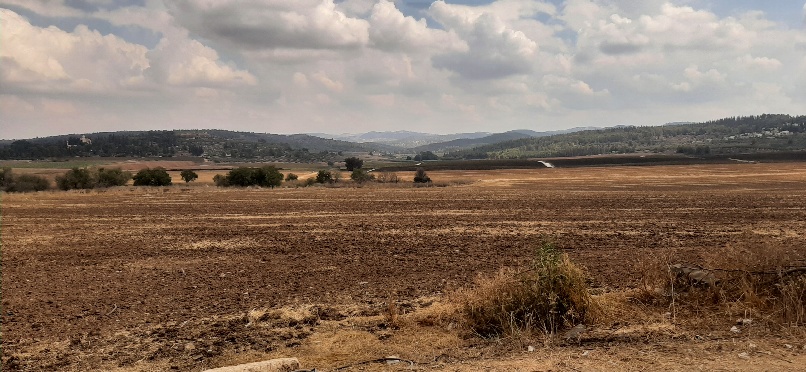
View over Ayalon Valley
An old Arabic structure appeared on the side of the road, prsumably a sheikh tomb, a common landmark of the Arab Muslim habitation. We stopped to look at it, but the structure next to it was even more interesting.
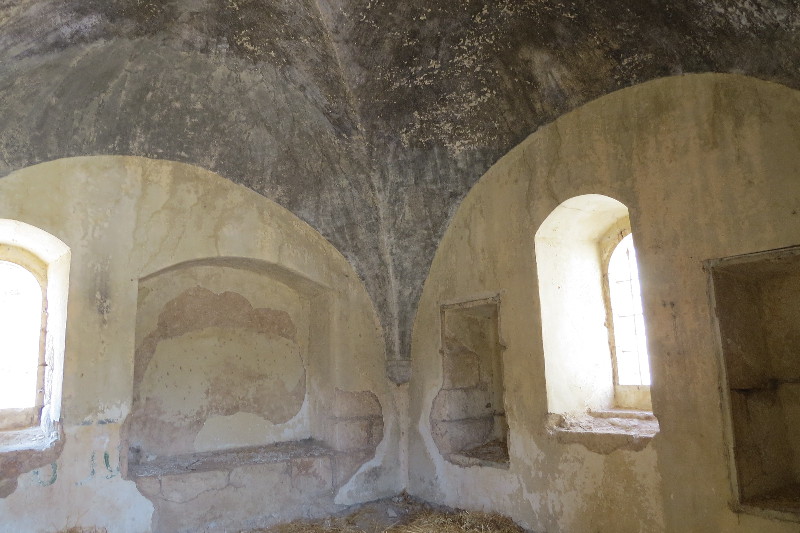 The Arches House, where Meir Tobiansky was executed by the Hagana.
The Arches House (Beit Hakshatot) is an impressive building thrown in a desolate environment covered with prickles and wild fennel stalks.
A sign told a grim story. On the 30th of June, 1948, during the War of Independence, an unofficial field court wrongly executed an IDF officer, engineer Meir Tobianski RIP, for informing the enemy of the location of essential Hagana facilities. A year later, though, he was cleared of all charges and got a proper burial as an IDF MIA due to that error.
It was weird walking into the building with that prior knowledge, but we did nonetheless and also took pictures.The building itself is architecturally magnificent.
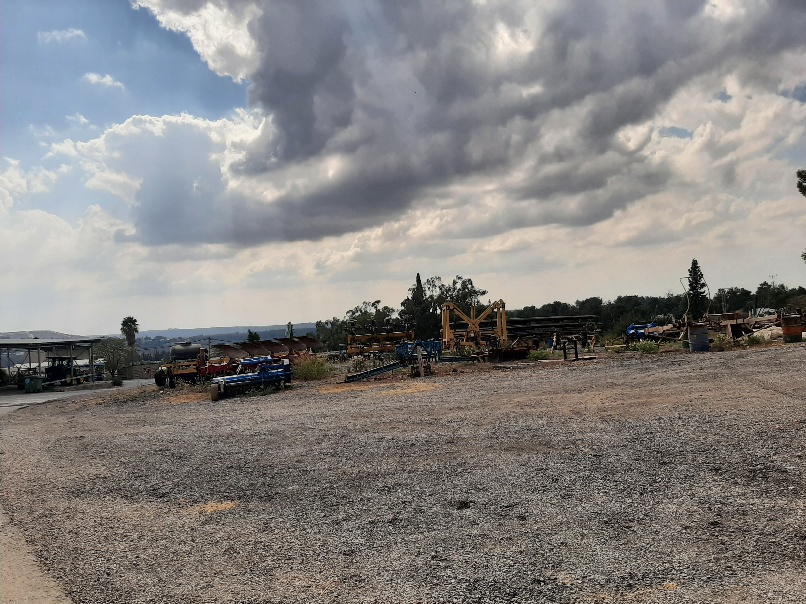
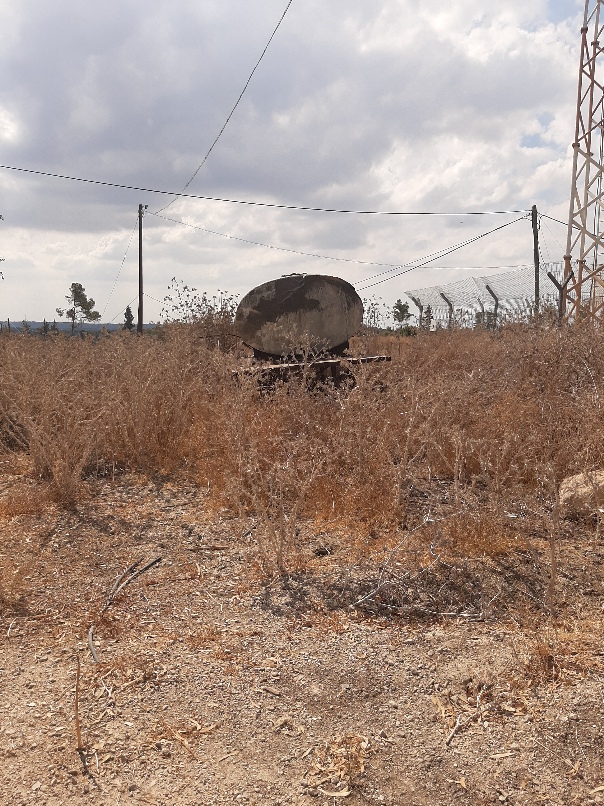
From there, we walked through the brambles, with my friend following invisible paths shown on his application, and eventually reached the backside of Kibbutz Har’el. Like every Kibbutz, there is always an area where old machinery and other agriculture–related objects are waiting to be rescued. This was no exception, and with the context of the Burma Road, it felt even more forlorn and deserted.
Shirts and towels were hanging by a utility shack, maybe a hangout spot for workers or for kibbutz youth. A strange mix of citrus trees, some defying definition, hosted several plastic chairs, enabling us to sit for a minute and gather ourselves.
A sign in the midst of nowhere announced:
If Agriculture is Here, The Homeland is Here.
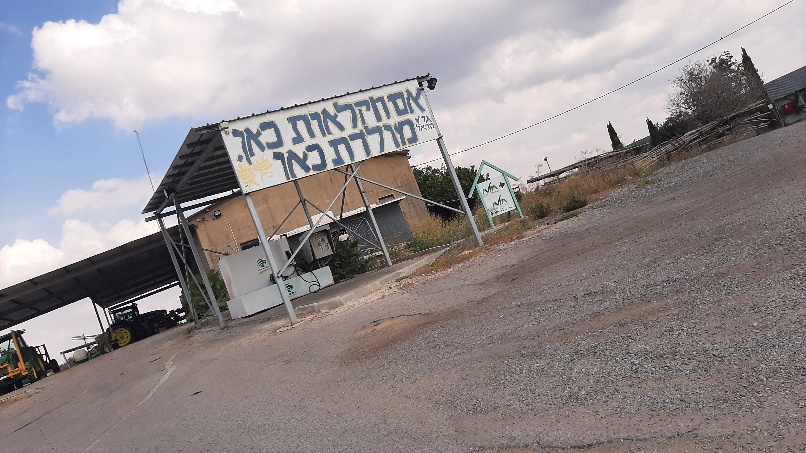 A sign announcing that wherever there is agriculture, there is the homeland.
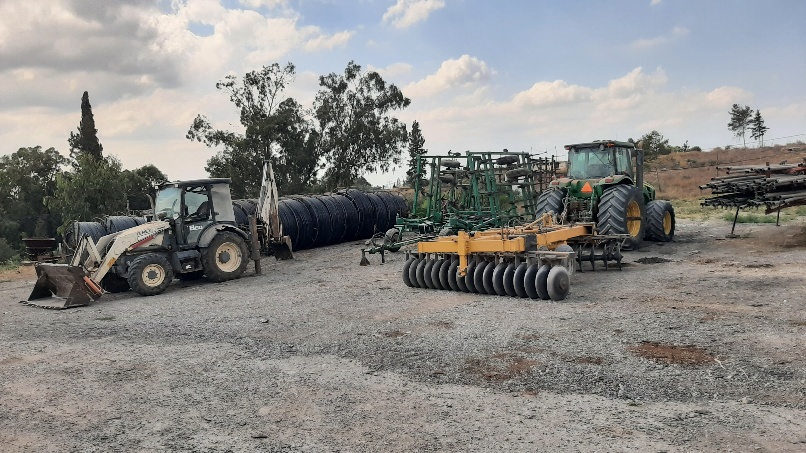 Agriculture machinery, Kibbutz Har’el
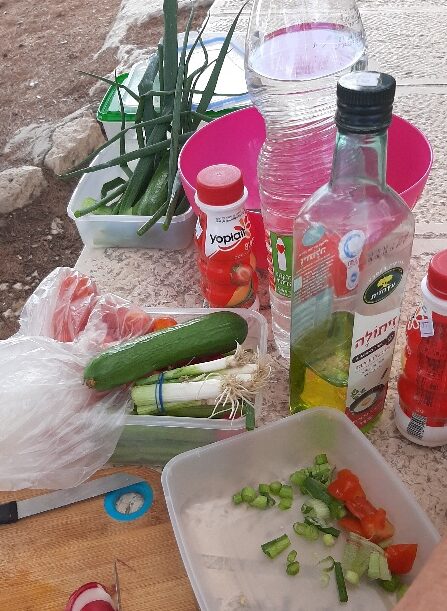 We stopped by the Har’el Lookout to have lunch. The stone house nearby used to be the school of the Arab village of Beit Jiz. During the war, the 7th Armored Brigade (Hativa Sheva) monitored the traffic on the road from here.
Left: A hearty salad at Mitzpe Har’el
We sat on a wall by the sculptured model of the area to cut the vegetables we brought with us, and ate the freshly-cut salad to our relish.
After the meal we rested below the structure, watching the picturesque view. Above us, a “celestial Burma Road” cloud creating an “as above so below” phantasm..
Serpentining our way around the Serpentines
The sun was westering as we approached ‘The Serpentines”, the most difficult and challenging part of the Burma Road.
We started our walk as a casual flat stroll in a KKL-JNF planted pine forest, yet at a certain point my friend insisted we take a narrow path seemingly just to get off the beaten track.The path meandered down the hill, and my friend asked if I understood we will eventually have to climb it back. I said sure, alright, not realizing this was quite a challenge actually. The side “stroll” lasted longer than I anticipated and it was getting darker, yet my friend did not reveal his cards for taking me here.
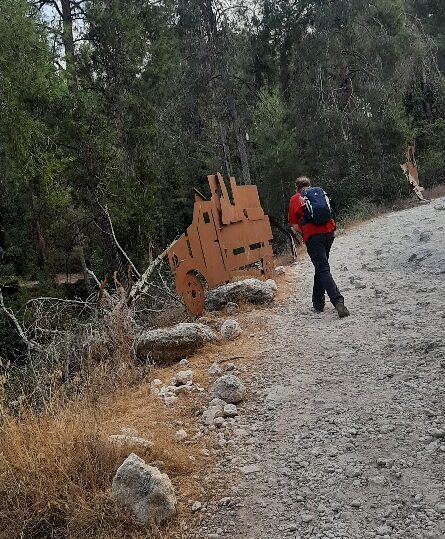
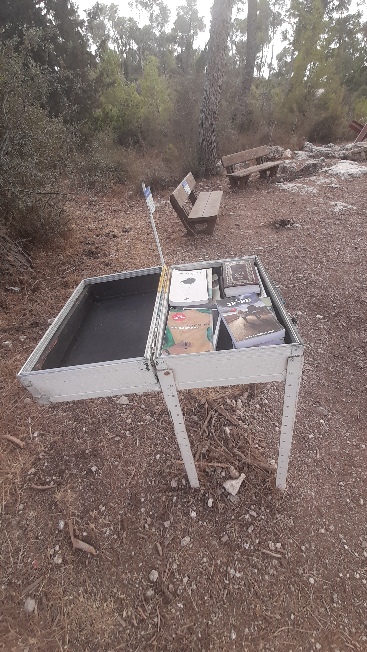
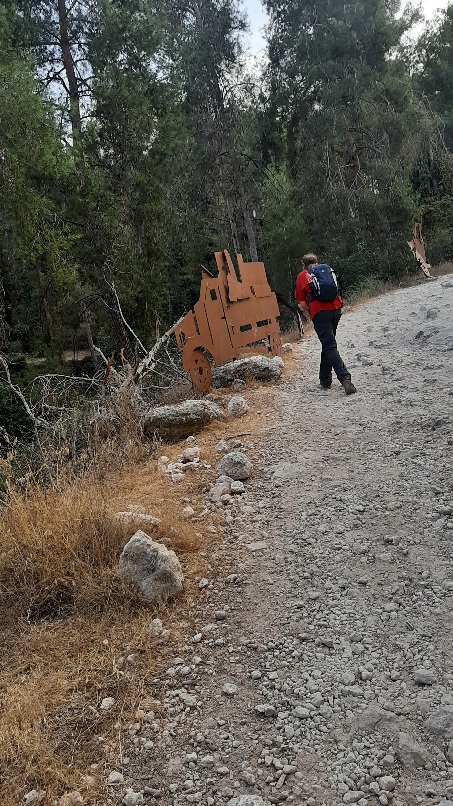
Left: Heading towards the most difficult part of the serpentines. Right: A field library
The path eventually found its way to a dirt road, which started to climb back towards our car park. Almost at the top, various signs and images revealed themselves, denoting the heroic efforts invested to traverse this most challenging section of the Burma Road – the Serpentines – in 1948.
When things come as a surprise, they always have more power and impact.
Burma Road was hastily constructed to bypass the main road to besieged Jerusalem. 1948
How the Serpentines were traversed back in 48
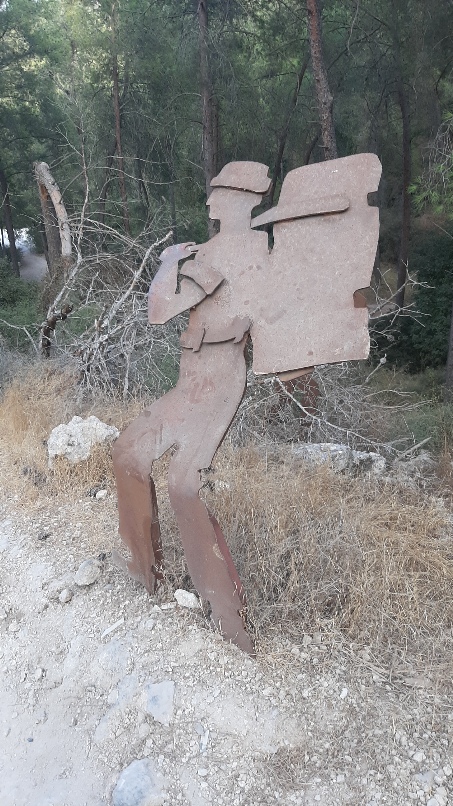
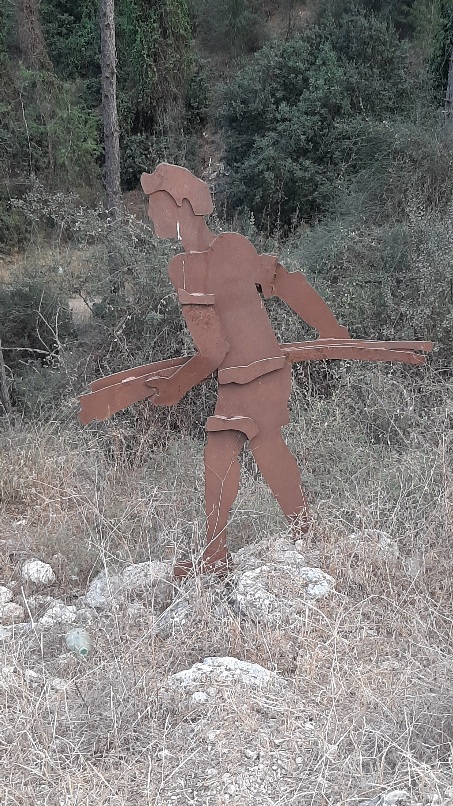
Figures depicting labor done on the serpentine section of the Burma Road to enable vehicle traffic. The guy on the left is carrying a sharpa
Although the Burma Road was made drivable up and down from that point, the so-called Serpentines posed the biggest challenge to the vehicles trying to reach Jerusalem. This 2-km long stretch of the road was initially traversed by foot and mule, with porters carrying the stuff downloaded from the trucks and jeeps down the steep climb to vehicles waiting at the lower end. Water for the thirsty city was pumped into a makeshift pipe improvised over the terrain.
The passage was opened for vehicles June 10, 1948, as special metal supports (sharpas) were placed along it to enable driving.
We ended our sojourn along the Burma Road with a stop by the freshwater Hila Spring at the junction between the Burma Road and the Ayalot (gazelles) Rd. That last road served Giv’ati armored vehicles before the Burma Road was established.
From here we drove yet another section of the dirt road until we joined with the busy traffic of highway #1, the main artery to Jerusalem today. Along the side of the road you can still see remnants of the old armored vehicles from 47-48 as well as the memorial to those who had fallen trying to break through the beleaguered road to the city.

Powerful and elegant memorial by Highway #1 – tribute to the heroes who traversed the road to the besieged city, and often did not make it. (source: Tourism Mate Yehuda)
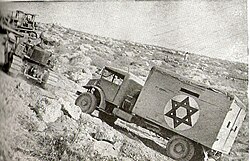 A bulldozer tows a truck on the Burma Road, 1948 (Wikipedia)
So what was the situation in Jerusalem and vicinities in 1947-8?
Independence War basics
The Independence War started in November 1947, right after the United Nations decision to partition the land and establish a Jewish and an Arab state side by side. In the first phase of the war it was mostly the local Arabs who attacked the Jews, but after the end of the British mandate on May 15th, 1948, seven armed forces attacked the small nascent Jewish state from all sides. The war continued until the beginning of 1949 with the signing of the armistice agreements.
If you can call the outcome of any war miraculous, this was the one. The juvenile country, devoid of most military equipment real armies have, had succeeded to repel 7 armed forces and most of the local militias, to add territories and to gain true, lasting independence and sovereignty. It is extraordinary, and you can find plenty Israeli sources on the Net to get detailed info.
If you are knowledgeable on the subject-matter and find any historical errors in my description below, write them down in the comments section, and I will correct if needed. Thanks.
Here are the relevant milestones:
- Nov 29, 1947: UN passes partition plan.
- March 1948: The road to Jerusalem is effectively blocked.
- May 14, 1948: British depart; Israel declares independence.
- May 28, 1948: Jewish Quarter in the Old City falls.
- June 10, 1948: Burma Road opens, alleviating the siege
The battle for Jerusalem – the convoys and the siege
Jerusalem at that time was home to about 100,000 Jews, most of whom lived in the Western city, and to 65,000 Arabs, most of whom lived in the Eastern parts. The Jewish communities depended exclusively on provisions from the coastal areas via the only existing road at the time.
Right from the beginning of the war, local Arabs from the various villages and towns alongside the road attacked the convoys attempting to bring supplies to the city. The road was blocked in several locations, notably Ramla, Latrun and Sha’ar Hagai (Bab el Wad). The most critical and dangerous point was the narrow bottleneck at Sha’ar Hagai, where Arab gangs were shooting from the surrounding hills over any vehicle trying to pass.
The relief convoys, mostly improvised out of old trucks, were repeatedly attacked and suffered heavy casualties. Some remnants of those vehicles can be seen on the side of the Tel Aviv-Jerusalem road, in memoriam. Nearby, a new and excellent historical museum was built, featuring the convoys saga and the battles for Jerusalem. You can read about it in my post, Khan Sha’aar Hagai, commemorating the convoys to Jerusalem.
Roads to the city from the east and south were also blocked for Jewish traffic.
The siege was complete by March 1948 and lasted until June 10th, and for three months, the besieged population could not get food, water, medicine or ammunition. Famously, people pumped remnant water from old cisterns, and some resorted to eating herbs and wild plants. The Burma Road was made operational June 10th (see below), and convoys of supplies and water started trickling into the city. If this had not happened, you would not be reading this post, as I would have never been born.
The battle for Jerusalem and vicinities – the failures
Another major siege took place around Gush Etzion, a block of four Jewish settlements southwest of Jerusalem. Attempts to break the blockade failed, with many casualties on the part of the convoys which tried to break through. Kibbutz Kfar Etzion attempted to surrender, but despite the white flags, everybody but three survivors were massacred by the Arab mob. In the wake of that atrocity, the policy was to evacuate other isolated settlements to the east, south and north of Jerusalem, like Atarot, Neve Ya’akov, Kalya and Beit Ha’arava near the Dead Sea, and the other three villages in the Etzion block.
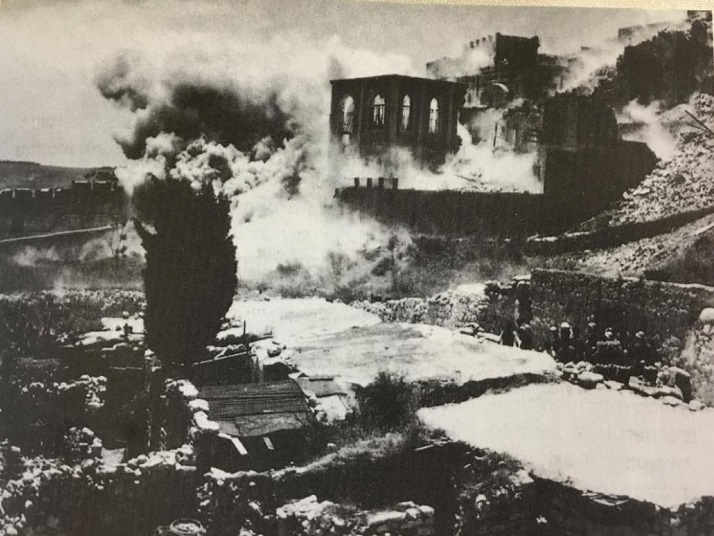 The fall of the Jewish Quarter. Source: https://blog.nli.org.il/en/hoi_jewish_quarter/
In proper Jerusalem, the Jewish Quarter in the Old City was also surrounded, and the combatants were obliged to surrender to the Jordanian Arab Legion on May 28, 1948. The residents were forced out and the synagogues demolished.
In contrast, the western city was liberated by a series of operations, mostly successful, including the Nachshon, Danni and Yevus operations. A failure would have meant mass slaughter or deportation.
Operation Nachshon
Operation Nachshon was conducted by the Haganah to clear the strategic hilltop villages along the last few miles of the road to Jerusalem, and took place in the first two weeks of April 1948. A particular effort was concentrated on the Castel Fort, overlooking the road to the city on the eastern part. After 8 days of fighting with the site changing hands frequently, the Castel stayed in Israeli hands, making the trip to Jerusalem somewhat safer for a while. Today it is a national park and heritage site.
Operation Nachshon enabled three large convoys to reach the city, followed by the Har’el Operation which enabled three more to cross, but the road was barred again by the 16th of April. The food delivered by those convoys enabled the city to survive meagerly until the opening of the Burma Road.
The Burma Road and how Jerusalem was saved
On May 15, a day after the British departed, the Jordanian and Egyptian armies joined in to reinforce the Arab militias, known as the “gangs” (knufiot) who had already initiated the blockage of the roads as early as December 1947. An urgent need arose to find a hidden alternative route to bypass Latrun. Salvation came when the Burma Road, named after an emergency supply line in China during WWII, (see above), was paved clandestinely.
The Burma Road ran south to the main Jerusalem road, and almost parallel to it, on difficult terrain. For precision, I will note that it did not bypass the Sha’ar Hagai bottleneck directly, and joined the main road at a point that was less threatened, but it did circumvent Latrun.
Once the road was opened, a series of massive armored convoys, involving hundreds of vehicles, broke their way through, and a water pipe was installed.
The heroic Har’el Brigade had succeeded to control most of the hills on the way to Jerusalem, as mentioned above, but Givati and the 7th Brigade failed to conquer Latrun, which remained under Jordanian control until 1967 (see below).
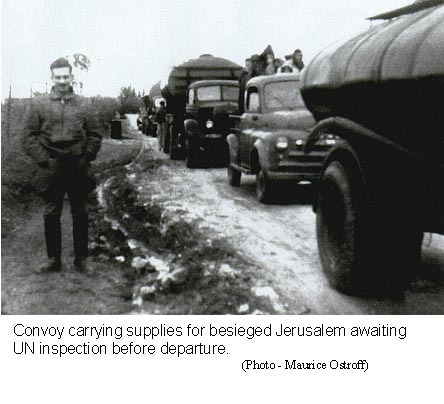
In the beginning, this emergency road was so hazardous in parts that the convoys resorted to mules and donkeys to carry the supplies. Because of the difficult terrain, the first vehicles used, mainly jeeps, had to be pushed by hand in some places (see Yael’s story above). The steepest, hardest section of the road was opened to vehicles June 10th, 1948, and the road was completed on June 14.The siege ended July 11. Water and fuel pipes were also laid along it. By the end of June, nightly convoys delivered 100 tons of supplies a night. During the first truce, June 11th to July 8th, 8,000 truckloads had arrived in Jerusalem, and my family could breathe again.
.
 Convoy returning to Tzrifin camp from the Burma Road
The Burma Road remained the sole supply route for several months, until the opening of the Valor Road (Kvish Hagevurah). After 1967 and the takeover of Latrun by the fourth brigade, road 424 was reopened and used until the eventual inauguration of highway 1. Yes, I know it’s complicated (see above::”Road Confusion”). I’m still scratching my head to understand it all and connect with pictures in my mind of the actual terrain.
Operation Yevusi
The Palmah Operation Yevusi was carried out to gain better Jewish control over Jerusalem. It lasted two weeks, from April 22,1948 to May 3rd, 1948. Not all objectives had been achieved before the British enforced a ceasefire. However, the operation had succeeded to take the neighborhood of Katamon and the vicinity of the San Simon Monastery. It failed to take Neve Ya’akov, Atarot and the surrounds of Mount Scopus, which theoretically stayed in our hands, but stayed disconnected from the western city until 1967.
Operation Dani
Dani was a partially successful operation, conducted right after the first Hafuga (ceasefire), with the aim to widen the so-called “Jerusalem corridor” by taking over Lod, Ramla, Ramallah and Latrun. Lod and Ramla were indeed taken, including the airport and the train station, helping protect and control the coastal area. Nonetheless, as described below, the effort to take over Latrun and Ramallah failed. Operation Dani took place between the 10th and 18th of July 1948.
The battle over Latrun
The battle over Latrun was part of the Dani Operation mentioned above and carried out by the Alexandroni, Har’el and the 7th Brigades. Two separate attempts to take the area failed with many casualties, many of whom “rookie” soldiers who had just arrived from the displaced persons (DP) camps in Europe straight to the battlefield..
In the context of the siege on Jerusalem, the “Latrun Traffic Jam” was yet another choke point along the main road to the city.
The Jordanian Legion, trained and often commanded by the British, took up strategically superior positions at the Latrun Monastery and the police station which dominated the road. Fierce battles took place between the Legion and the smaller, ill-equipped Jewish forces.
Famously, in the first attempt to take Latrun, Ariel Sharon, serving as a platoon commander, got seriously wounded. He was evacuated under fire, his life on the line, an experience which affected his later positions and career as a high commander in the IDF, as minister of defense and eventually as prime minister.
Aftermath: 48-67, The Latrun “Bulge” and more road trouble
In the 1949 Armistice Agreements, the Latrun area remained a salient under Jordanian control, in turn surrounded by a perimeter of no man’s land. Under the cease-fire agreement, Jordan was not to disturb Israeli travelers using the road, yet in practice, constant sniper attacks led Israel to build a bypass road around the bulge.
Due to that failure, and prior to the war of 1967 when we finally took over that piece of land, we needed to circumvent the Jordan-controlled Latrun area, through what are now Roads #44 and #424. This, of course, lengthened the span of time needed to get to Tel Aviv, which made the trip into a bigger ordeal than it should have been.

Related Posts


Comments (0)