Skip to content
Nir Keinan is telling us about the Druze, theri religion and history under the belessed oak tree

Under the Oak Tree in Yanuh-Jat- Intro to the Druze

Yanuh-Jat - Under the Oak Tree

Under the Blessed Oak Tree in Yanuh-Jat

Nir Keinan is telling us about the Druze, theri religion and history under the belessed oak tree
Nir Keinan seated under the blessed oak tree in Yanuh-Jat, telling us about the Druze

The tour

This was a day tour organized for senior citizens of the Misgav Regional Council, aptly namd “Druze, The Mountain People“. We drove to four Druze villages, two of which, Jat and Yanuh, now actually count as one. The first stop was the “blessed tree”,”The Mubarakah” in Yanuh-Jat – a huge oak, believed to be about a 1000 years old. In a land characterized by long, hot summers and strong solar radiation, big trees are indeed a blessing.

Sitting underneath, we enjoyed the shade, the camaraderie and the inspiration, as people had for centuries, while our illustrious tour guide, Mr. Nir Keinan, told us stories and facts about the Druze. The blessed tree and the spirit of Abu Arus must have inspired me as well many before and after me, and, though I planned to write but just one post about the trip, the muse brought about a proliferation of no less than seven… They are now assembled under the title:, “Druze, Israel’s Quiet Allies – History, Current Events, Women, Religion and More” 

The blessed Tree landmark of Yanuh-Jat

People come from all over to kiss the ancient tree, ask for blessings and perform rituals and ceremonies around it. In particular, brides and grooms circle the tree again and again, asking Abu Arus (see below) and the tree for love and abundance. This custom is common for many other blessed trees in the Druze world.

As different from Muslims, Druze consider these distinctive trees “blessed” rather than “sacred”.That means that the special powers the tree is endowed with and bestows on the people come from the spiritual man who blessed it, and whose spirit imbues the premises.

Not just the trees, I observe, Druze villages tend to be greener and cleaner than Muslim villages, with geranium pots over the stairs and balconies, gardens by the houses with flowers, vegetables and fruiting trees.

In research done on sacred and blessed trees, it was found that kissing trees “seems to be almost exclusive to the Druze. They explain that “kissing the “blessed tree” is to receive a blessing, as the kissing is done in a sacred grave. The same is regarded for putting the palm of one’s hand on the tree.”

The sad history of trees in The Land

Trees in the land of Israel have suffered greatly over its bloody history of conquests, under the reign of neglectful, careless, exploitative empires, and always at the mercy of wild Bedouin incursions with their herds of black goats.

The land was devastated by uncontrolled, relentless goat pasturing for millenia. Trees were cut for everything from firewood to construction to the British /Turkish railways. All that, and the endless wars, brought about the destruction of most of the original native forests of The Land, until Zionism, which took it as a mission to replant and green the land again. 

Stripping trees of their souls- Jewish monotheism

Monotheistic patriarchal Judaism waged a war against the local Goddesses tree cults, like the Ashera, and stripped trees of their former holiness and soul. Trunks were cut daily to serve as firewood for the endless Temple sacrifices.

Muslim times – save a tree for the sheikh 

In Muslim times, single big, old trees were left out of the axes’ wrath near sheikh tombs and holy places. Only in these places we can view them in their full glory.

The above-mentioned article describes the Muslim view of the sacred tree: “It is agreed that there is a similarity between sacred trees and graves of Muslim saints (Wellis). The spirit of the Welli dwells in his grave or his shrine or in a tree which is dedicated to him. It is not surprising to see the close similarity between the ceremonies and rituals that are performed in a saint’s shrine/grave and at a sacred tree.”
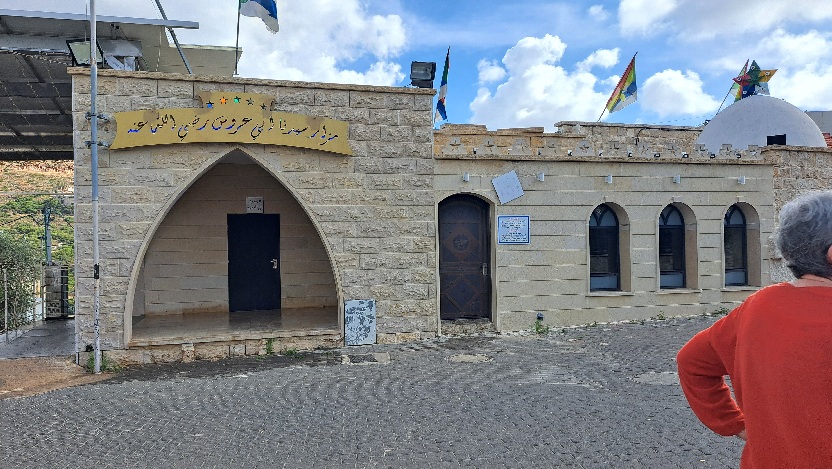
Druze Hilwe with the 5-colored flag and star by Abu Arus's Tomb in Yanuh -JatThe Hilwe and Abu Arus’s tomb, Yanuh-Jat.

Abu Arus – religious messenger for Yanuh-Jat

The tree is only one landmark. Right next to it is the Hilwe, a prayer and study house and adjacent to it an 11-th century tomb, the presumed burial of Abu Arus, the so-called Father of the Bride.

Abu el Arus was one of the men spreading the Dawa (the Wisdom), with the original group of Druze who escaped Egyptian persecution (see my posts onDruze Secret Religion  – for the Chosen Few,and on Israel’s Mountain Allies and Tactics of Survival ). These men preached, taught and acquired a growing group of faithful.

The tomb was built over the cave in which Abu Arus presumably dwelt, and a dome was built over it. The entire complex serves as a pilgrimage site.  

Yanuh-Jat - Building for Protection

Yanuh-Jat - Druze star over Abu Arus's tombFive-colored star over the tomb of Abu Arus, one of the original messengers spreading the Druze religion in Yanuh-Jat

The actual village of Jat was built in the 17th century, when Druze from Syria and Lebanon migrated to the area. They loved the hill and the fertile land, found it suitable for habitation, but decision was finalized by virtue of the holy ancient tomb site of Abu Arus. 25 families settled on the hill, and for protection built a wall around the village. For increased safety, they also connected the roofs and paved very convoluted alleys to make invasion difficult. Each house had its own well.

Check my post a bout Druze tactics of survival mentioned above for more about the need for protection and building up on top of mountains. 

The name Jat is probably a variant on the Biblical Gat, the stone structure where wine and olive oil were produced. Many Gitot were found in the area, dating back to the iron age.

From the complex of tree-hilwe-tomb we got back on the bus and drove to a hill nearby, where the Druze military cemetery of Yanuh-Jath is located.

Under the Tree in Yanuh-Jat: Nir Keinan's intro to the Druze Community

Origins

As our guide, Nir Keinan, told us as we made ourselves comfortable under the tree, the Druze religion developed from the Fatimid Shi’a movement in Egypt. According to him, the religion emanated straight out of the head of Hakim bi-Amr Allah, the caliph who started ruling over Egypt at age 11. It is not clear if the religion can be ascribed directly to him, but what is certain is that after his death, or ascent to the heavens if you will, his enemies started persecuting this new religion viciously and relentlessly, and they are still at it. More on that and Druze history in my posts “Druze Secret Religion – for the Chosen Few” , “Druze Israel’s Mountain Allies and Tactics of Survival, and “Druze Crisis in Syria – Horrors, Analysis and What Next”.

According to the Shi’a tradition, there is a continuation of revelation after Muhammad – his nephew Ali and the Imams. The Sunnah, in contrasts, does not allow for new prophets or revelations. Bi-Amr Allah brought to his palace in Cairo modernist religious scholars, including Hamza Ibn Ali and Al Darazi. They were the ones who wrote the wisdom books.

Persecution 

In 1821, Hakim bi-Amr Allah was murdered, or according to the Druze tradition, merged back to the Source. Following his death, the Michna, persecution at the level of genocide, immediately commenced. “This persecution of the Druze included massacres, demolishing Druze prayer houses and holy places and forced conversions to Islam – essentially attempts at genocide.

In 1957, Israel was the first, and is still the only country worldwide to recognize the Druze as a distinct ethnic minority community. It should be noted here that Muslims abhor the Druze even more than they do Jews (and there is no love lost here, as everybody knows). To them the Druze are traitors, defectors. They “have seen and tasted the sweetness of Islam and knowingly chose to leave it”. In their world view, that violates the religion’s reputability and behooves upon them to wage a holy war against the renegades. For that reason, as we now see in Syria, there are always some Sunnis who never rest in their murderous instincts regarding the Druze. It is important to note that this is not new.

Dissemination

Survivors from that onslaught escaped north to Hasbaya (Hasbeiya) in Lebanon, settled there for a while and started spreading out and disseminating their faith to people in the region. Many people joined them at the time, including blue-eyed and pale-skinned tribespeople from the Caucasus.

Insulation

In spite of that success, and due to the fear of further persecutions, in the year1043, after 22 years only of expansion and proselytizing, the Druze closed themselves to foreigners entirely, and stayed that way since. Naturally, this kept their numbers small. Conversions are not permitted in the Druze religion, because they believe that the first generation after the establishment of the Druze religion had the opportunity to join the religion. They believe that every Druze person alive today is reincarnated from that generation. Intermarriages are generally discouraged. The children of such marriages are not considered Druze anymore.

Being so genetically secluded, many studies were done of Druze genetics. Interestingly, A high level of Caucasian Armenian DNA was indeed found in the Israeli Druze population.. Findings by Marshall et all, published in a Nature article, suggest that “the proto-Druze were from tribes who resided around the Zagros and surrounding mountains, and Syrian tribes with whom they exchanged genes, subsequent to, and after, their migration to Palestine.”

So where can you find the Druze?

The Druze live primarily in three countries: Syria, Lebanon and Israel, and they are loyal to whichever country they live in.

There is a small Druze Diaspora in North America and in Latin America, especially in Venezuela, as a result of the civil wars in Lebanon and Syria. As a consequence, the national Druze drink is mate….

In Syria, the Druze mix out more, also because under the Assads there was a separation of religion and state.

Israeli Druze - Basic Facts

The Israeli Druze

In Israel, Druze live in 23 Druze-only villages, and in about 10 more mixed villages, all in the Carmel and Galilee regions. There are four Druze villages in the Golan Heights, including Mount Hermon area, the tallest mountain in the Levant. Most of these settlements are located in high mountainous areas, as I elaborate in my post  “Druze – Israel’s Mountain Allies and Tactics of Survival”. 

The Druze do not have a world center. There are holy sites like Nabi Shuayeb in the Arbel Valley near Tiberias, Nabi Sablan in Hurfeish and Makam El Nabi el Hadr in Kfar Yasif, where according to the Druze, the Prophet Elijah reincarnated as a Druze prophet, Hadr. 

Since Kfar Yasif is considered neutral in terms of family and clan feuds, with only 3% Druze population living there, the Druze secular institutions, like the court and the legislative council, were placed there, to minimize frictions. The spiritual center is in Julis. (See my post.Druze Cemeteries – State, Religion and the Soul”).

Population

According to Nir, and you can check it out for yourselves, there is an estimated 140-150,000 Druze in Israel, including the Golan and Hermon areas, which count for 27-28,000 souls. The Druze constitute about 1.5% of the Israeli population and 10% of the Arab population.

125,500 of them are Israeli citizens, and by agreement only the men serve in the army. Many of the Golan Heights Druze still see themselves as Syrians and refuse to get Israeli IDs. The horrid Syrian civil war had changed that somewhat, and now more Golan Druze wish to become Israeli citizens.

Prior to independence, there were only 15,000 Druze out of a population of 1.3 million Arabs in mandatory Israel. 160,000 Arabs stayed after the establishment of the state. The rest, and their great-great-great grandchildren  are considered by the world to be refugees, even after 77 years. Today, Israeli Arabs count again as 1.3 million. The Jewish population at Independence counted only 600,000, and now we passed the 7 million mark. Both Jewish and Druze populations increased 10-fold, but for us it included massive immigration, and for the Druze it was mostly natural fertility plus the annexation of the Golan Heights.

Socio-economically, in the Arab sector the Druze are second only to the Christian Arabs in all fields of achievements. That includes matriculation grades, high education and employment.

Today about 30% of Druze are divorced. Nir said that something has been changing and disintegrating in the family structure. 

Druze, Israel’s Quiet Allies – History, Current Events, Women, Religion and More

In this post series I attempt to cover several topics pertaining to this fascinating and little-known religious group and ethnic minority in Israel, now on the top of world’s news. Here you can scroll through the topics according to your interest:

Under the Oak Tree  in Yanuh-Jat – Intro the the Druze; Israel’s Mountain Allies and Tactics of Survival; Druze Crisis in Syria – Horrors, Analysis and What Next; Druze Secret Religion – for the Chosen Few; Druze Cemeteries – State, Religion and the Soul; Yarka and Julis – Two Quaint Galilean Druze Villages; Druze Women Juggling Tradition and  Moderna.

If you like what you see and you want more, 

Subscribe to my newsletter

Orit

Comments (0)

Leave a Reply

Your email address will not be published. Required fields are marked *

Back To Top